Ontrack

Treating task paralysis by removing traditional to-do lists

Most productivity apps hand you a blank canvas and walk away. An open-ended backlog that becomes its own source of stress. This case study explores a minimal rethink of how tasks are captured, structured, and prioritised to reduce the cognitive load of deciding where things belong and how they're entered.

FOCUS

Task management, IA, UX Thinking

AREA OF WORK

Productivity & Wellbeing

ROLE

UX Design & Thinking

Read more

PROBLEM

Blank lists create blank minds

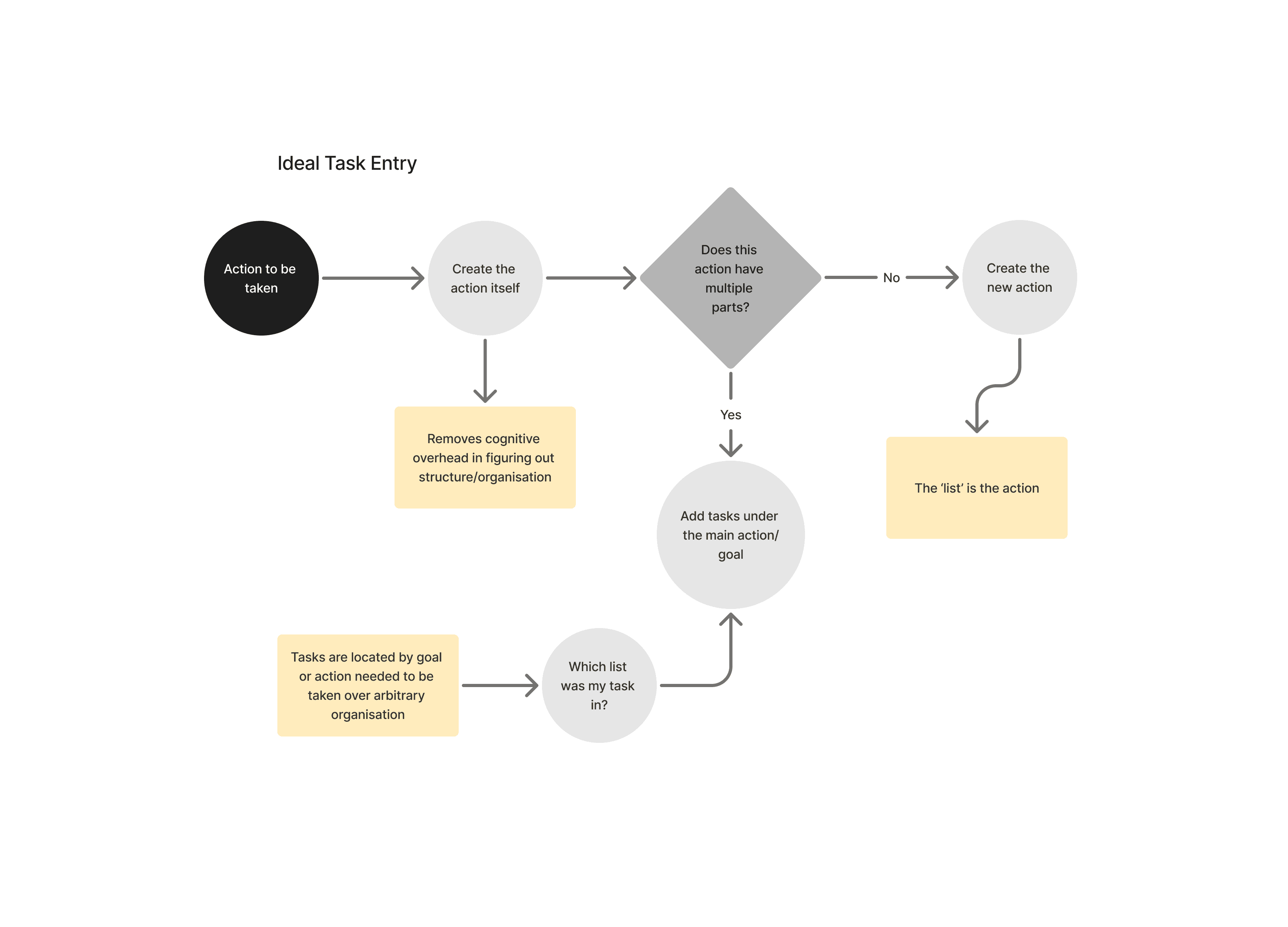
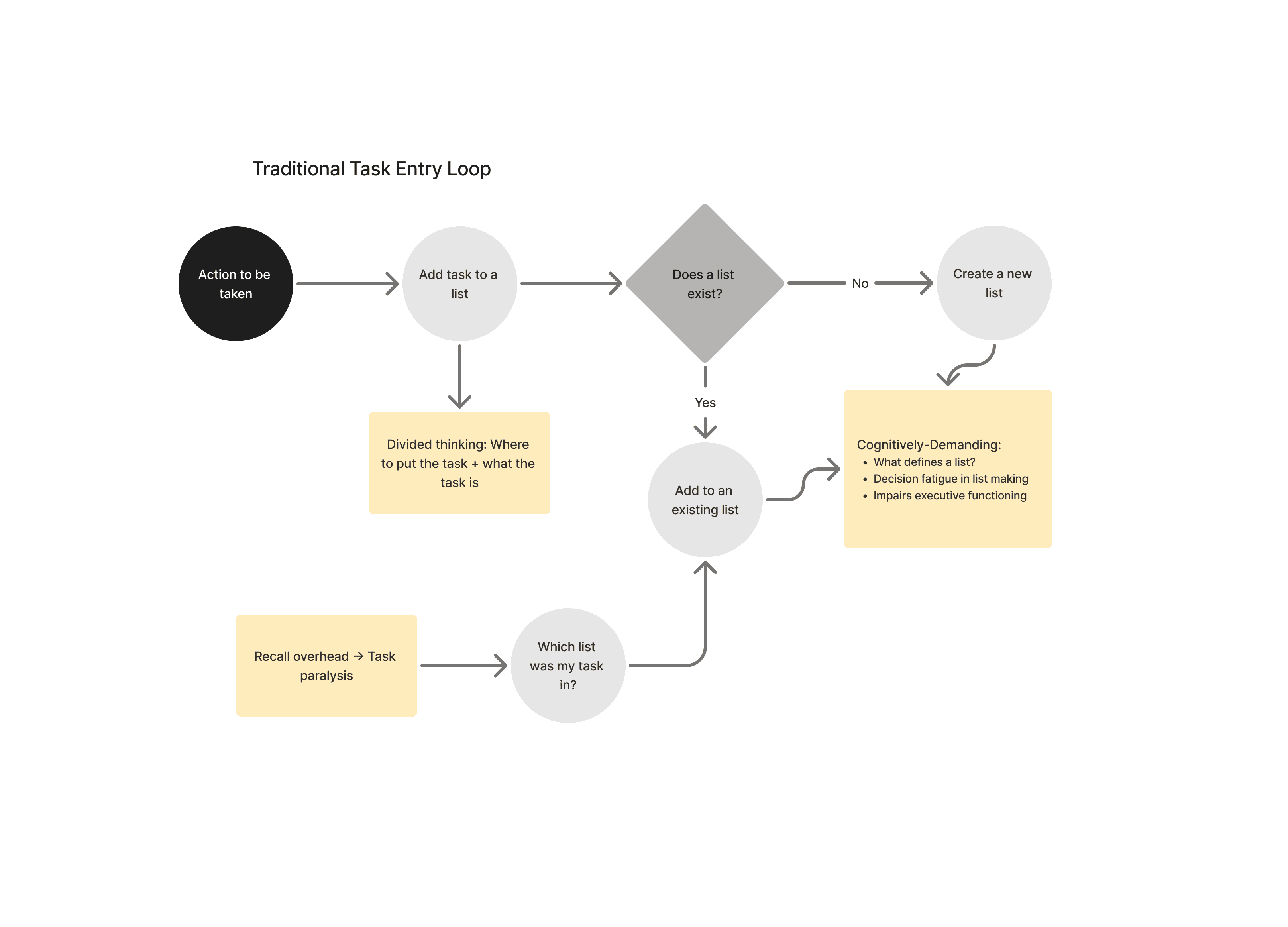
Conventional to-do apps place the full burden of organisation on the user, just like a folder system does. Every task requires decisions: which list does it belong to? Is this list still relevant? Where does this fit relative to everything else? For people prone to task paralysis this creates a stuck, overwhelmed feeling when a list grows faster than it shrinks and the friction prevents any meaningful work from really being done.
1

Open-ended lists don't end. Without a goal state, lists accumulate indefinitely. There's no moment of completion, and no sense of progress, aka the two things essential to sustained motivation.

1

Open-ended lists don't end. Without a goal state, lists accumulate indefinitely. There's no moment of completion, and no sense of progress, aka the two things essential to sustained motivation.

2

Sorting is a task in itself. Deciding how to organise tasks consumes the same executive function needed to actually do them and creates unnecessary cognitive overhead.

2

Sorting is a task in itself. Deciding how to organise tasks consumes the same executive function needed to actually do them and creates unnecessary cognitive overhead.

3

Priority gets buried.` When urgent and non-urgent tasks live side-by-side, the visual weight of the list obscures what actually matters most right now.

3

Priority gets buried.` When urgent and non-urgent tasks live side-by-side, the visual weight of the list obscures what actually matters most right now.

DESIGN APPROACH

Structure that makes organisation simple

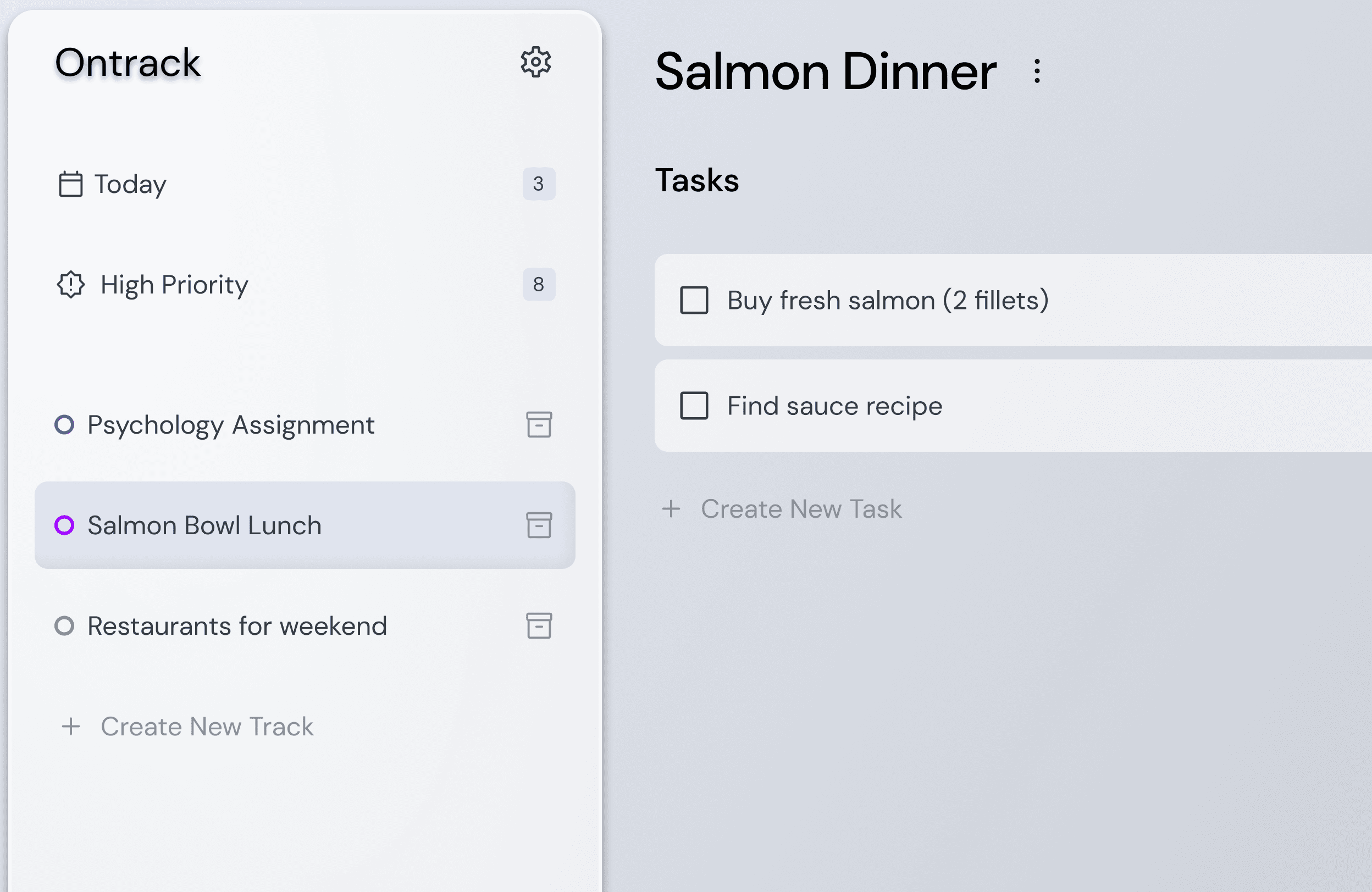
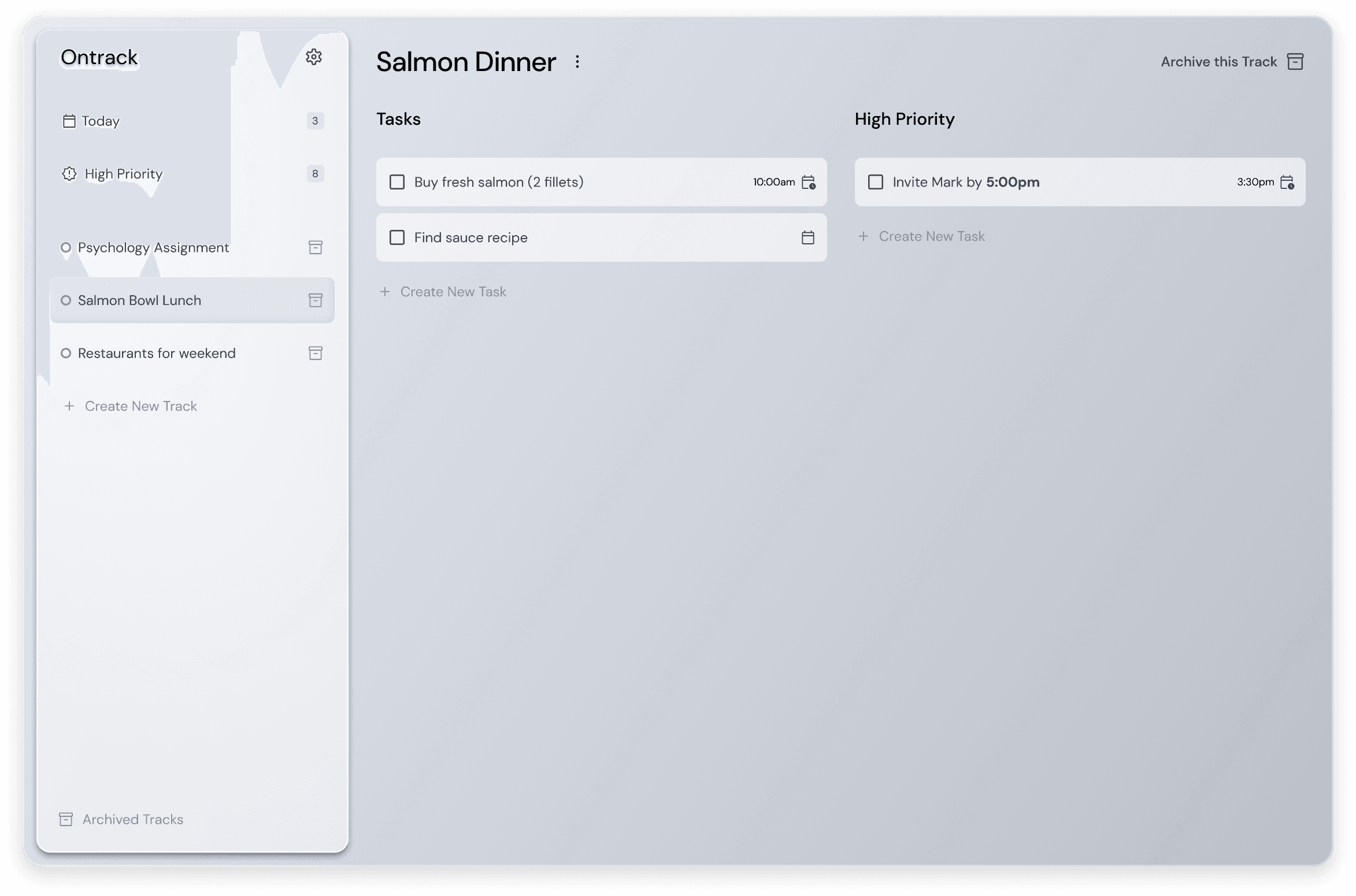
Rather than offer another blank list, the design introduces a two-tier structure: Tracks and Tasks. The hierarchy is intentional and it reduces the surface area of every decision a user has to make. Organisation is driven by goals, and any task is an action that needs to take place either on its own as a larger goal, or a smaller part within another goal.

1

Tracks, not lists

A Track is a goal-oriented container with an implicit end state so that when all tasks are done, the Track is done. Unlike open lists, Tracks are bounded. Completion is visible and real, which creates forward momentum.

1

Tracks, not lists

A Track is a goal-oriented container with an implicit end state so that when all tasks are done, the Track is done. Unlike open lists, Tracks are bounded. Completion is visible and real, which creates forward momentum.

2

Tasks belong somewhere

Every task lives inside a Track. The question of "where does this go?" is replaced with "which goal does this serve?" This is a much simpler, more intuitive framing that removes the sorting bottleneck entirely.

2

Tasks belong somewhere

Every task lives inside a Track. The question of "where does this go?" is replaced with "which goal does this serve?" This is a much simpler, more intuitive framing that removes the sorting bottleneck entirely.

3

High priority, visually separate

High priority tasks are pulled out of the main task flow and rendered in their own column which are visually distinct and impossible to miss. The contrast isn't just aesthetic; it's an attention mechanism that helps users find their hardest work without scanning.

3

High priority, visually separate

High priority tasks are pulled out of the main task flow and rendered in their own column which are visually distinct and impossible to miss. The contrast isn't just aesthetic; it's an attention mechanism that helps users find their hardest work without scanning.

DESIGN DECISIONS

Small tweaks that reduce friction at every step

Several small decisions compound to create a low-resistance experience, particularly for users who find that friction early in the flow is enough to make them abandon the tool entirely. For anyone approaching a new task management tool, they experience the overhead of needing to figure out how tasks are to be organised and management for the unforeseeable future - A very, cognitively demanding task.
1

Fluid task entry. Tasks can be added with minimal steps and the action is always contextually placed - no mode-switching, no navigation to a new screen.

1

Fluid task entry. Tasks can be added with minimal steps and the action is always contextually placed - no mode-switching, no navigation to a new screen.

2

Goals as organisation over structured lists. By swapping unmanageable lists for set goals, progression is always towards the completion of something larger and is dynamic in context to a users current life circumstances and priorities.

2

Goals as organisation over structured lists. By swapping unmanageable lists for set goals, progression is always towards the completion of something larger and is dynamic in context to a users current life circumstances and priorities.

3

Archiving over deleting. Completed Tracks can be archived rather than destroyed, preserving a sense of accomplishment and history - a subtle but meaningful gesture toward wellbeing and helps reduce the anxiety of having hard work disappear.

3

Archiving over deleting. Completed Tracks can be archived rather than destroyed, preserving a sense of accomplishment and history - a subtle but meaningful gesture toward wellbeing and helps reduce the anxiety of having hard work disappear.

OUTCOMES

A system that earns trust by just working

The core principal of the design is that a task manager should feel like relief, not administration. By embedding structure into the model through the bounding of Tracks, visual priority separation, and setting the core user loop to be focused on goal and completion over micromanaging, the app reduces the cognitive overhead of productivity to its minimum viable form thus adjusting for potential task paralysis.

Reduced decision fatigue

Making it easier to start

By removing the need to sort before capturing, users spend less mental energy on organisation and more on doing.

Clearer daily priority

The hardest work, front and centre

Visual separation of high priority tasks means urgent work is never buried beneath a wall of lower-stakes items.

Structure that scales

Without added overhead

The two-tier model stays lightweight as tasks and Tracks grow. the system organises itself rather than asking more of the user.
LEARNINGS

Learnings and Findings

As this was a prototype 1 version of the product, there were some key areas of improvement that could've furthered the core task loop we intended based off the problems discovered.

1

One-off tasks need a home that isn't a Track

Not every task belongs to a larger goal. Pre-built Tracks for areas like personal, work, and social would give standalone tasks a sensible default and remove the barrier to capture for anything that isn't yet part of a plan.

1

One-off tasks need a home that isn't a Track

Not every task belongs to a larger goal. Pre-built Tracks for areas like personal, work, and social would give standalone tasks a sensible default and remove the barrier to capture for anything that isn't yet part of a plan.

2

"Archive" sounded too technical - it should've been "complete"

Although the word Archive helped create a sense of preservation over deletion, using 'Complete' would've made more contextual sense when ending a Track, implying the goal has been reached, and the work is now, complete.

2

"Archive" sounded too technical - it should've been "complete"

Although the word Archive helped create a sense of preservation over deletion, using 'Complete' would've made more contextual sense when ending a Track, implying the goal has been reached, and the work is now, complete.

3

Task creation should be global, not per-Track

Navigating into a Track before adding a task makes capture a two-step process. A global entry point helped with the ability to assign or create a Track inline and keeps things fast and respects how ideas actually arrive. Inline text cues such as a Hashtag could've helped sort tasks into individual Tracks right from the text box.

3

Task creation should be global, not per-Track

Navigating into a Track before adding a task makes capture a two-step process. A global entry point helped with the ability to assign or create a Track inline and keeps things fast and respects how ideas actually arrive. Inline text cues such as a Hashtag could've helped sort tasks into individual Tracks right from the text box.

Dilan Omer © 2026. I had no idea what to include in the footer